← All case studies
How AchitectCo reviewed $9.85M in cost-to-billing differences
$9.85M
In the ten largest cost-to-billing gaps
577
Project records with recorded billing
88
Records with costs above billing
Clearer financial oversight
A ranked view of cost-to-billing differences, with amounts and responsible project managers.
Stronger fee discussions
Contracts, client requests and staff time brought together into a documented argument.
Less manual preparation
Mason compares records and assembles evidence that experienced staff previously had to piece together.
Specific technical findings
Submissions checked against project requirements, with missing evidence clearly identified.
TLDR: Mason connected AchitectCo’s financial data and project history, uncovered $9.85M in cost-to-billing differences, and prepared evidence for additional-fee discussions. Finance and principals received clear analyses backed by the firm’s own records.
Before: the report showed the numbers, not the story.
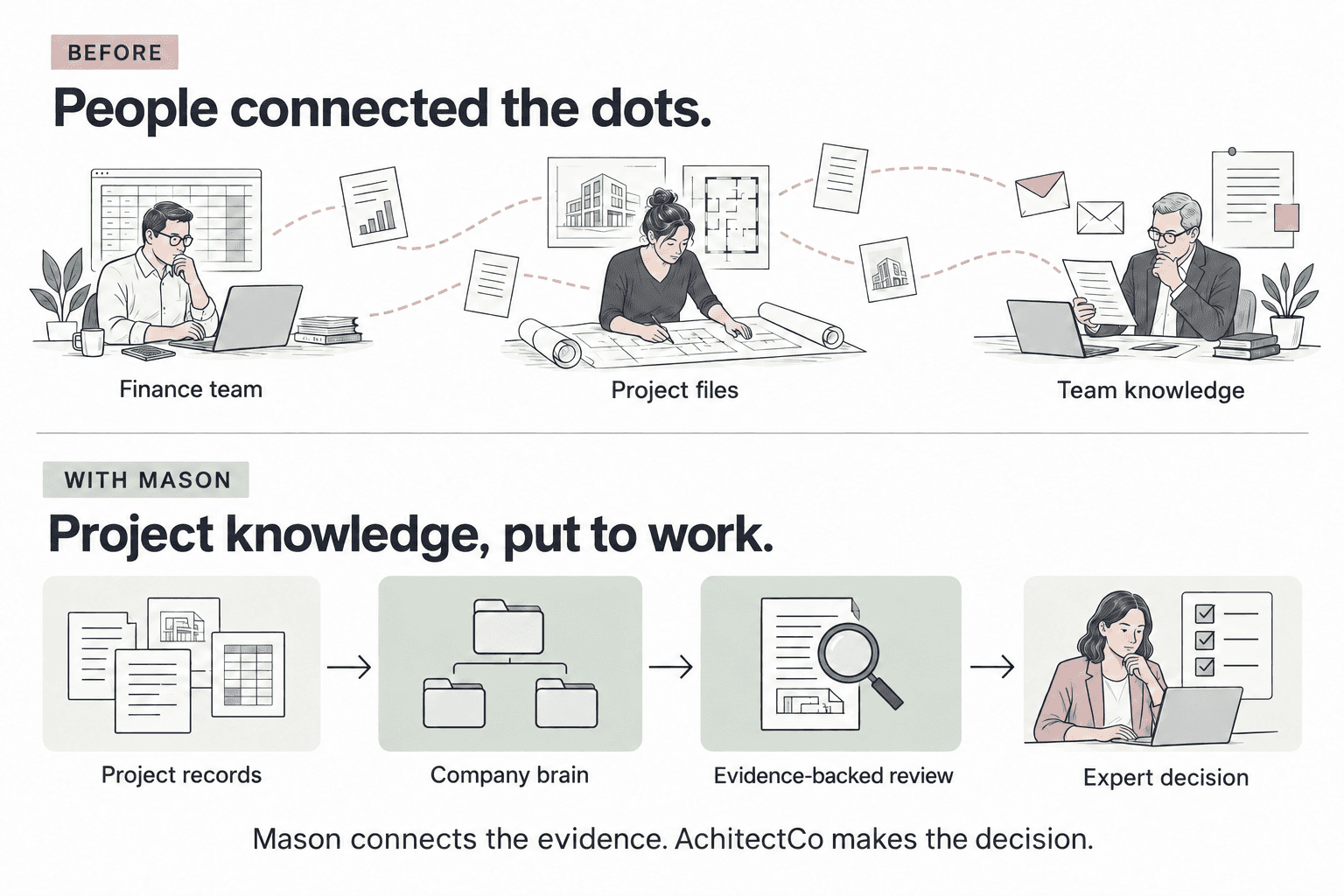
Project costs and billing lived in the ERP. The explanation often lived somewhere else: a contract amendment, a client email or a decision that only the project team remembered.
When costs ran ahead of billing, finance needed more than another report. Principals had to establish what the client had requested, what the original fee covered and what work the team had actually performed. Answering one financial question could mean working through months of project history.
With Mason: the records became a usable review.
Mason compared financial records, ranked the largest differences and brought the supporting details together. For commercial reviews, it worked across contracts, amendments, correspondence and staff time to build a documented case for additional fees.
The team no longer had to start with a blank page. Finance received a consolidated analysis. Principals received an evidence-based argument they could use in a client discussion.
A firm-wide review exposed $9.85M in differences.
An ERP diagnostic covered 1,500 records, including 577 project records with recorded billing. Mason identified 88 records where costs exceeded billing and ranked the exceptions by size. The ten largest gaps totaled $9.85M.
The output brought the amounts, underlying records and project-manager names into one analysis. Finance could see where the largest differences sat without assembling a separate view for each project.
These are recorded cost-to-billing differences, including accounting and internal tracking entries. They measure the scale of the findings, not fees recovered.
A principal turned project history into a case for additional fees.
In one review, a principal brought Mason the contract, amendments, correspondence and staff time records. The question was specific: which work came from new client scope, and which redesign was already included in the fee?
Mason organized the evidence around that distinction. It connected the client’s request to the contractual scope and the work performed, then helped prepare the additional-fee argument. This was more useful than a summary of the documents: it was preparation for a commercial decision.
The same approach made technical reviews more useful.
AchitectCo also used Mason to check product submissions against project requirements. One roof-hatch review covered 19 requirements. A curtain-wall review identified missing test data.
Instead of a broad summary, architects received specific findings to check against the project requirements. Financial reviews, fee preparation and technical checks all depended on the same capability: using the right project records to answer a precise question.
AI that fits the business, not another tool to manage.
Mason worked with finance, principals and architects on the decisions they already faced. The work was grounded in their records and their review process, rather than a generic AI demo.
The result was a clearer view of project finances, better-prepared fee discussions and more focused technical reviews. Mason handled the detailed comparison and evidence gathering; AchitectCo’s people applied their commercial and professional judgment.
← Explore more case studies