
TLDR
Start with institutional memory. Bring relevant quotes, challenged assumptions and operating lessons into the next deal review.
Connect evidence to decisions. Every material input should carry its source, date, scope and approval status through valuation, client advice and deal review.
Prove one useful handoff. Measure preparation time, correction effort and issues surfaced before expanding into more workflows.
In this article
Where deal teams lose time today
What the next deal should inherit
Building a graph of deal intelligence
Build in-house, with the right infrastructure
Use cases worth starting with
1. Where deal teams lose time today
Your firm has already paid for years of market knowledge and deal judgment. Why does the next deal still start with a blank model?
An analyst opens a data room. Somewhere else sits a pricing discussion about the same assumption, a sale or lease comparable, or an operating review explaining why a similar plan fell short. Finding it depends on remembering who worked on the last deal.
Often, the bottleneck starts before there is a complete data room. A client sends a few files, an old report and a property address. The team still has to establish what it already knows, what is missing and who needs to provide it. Faster analysis only helps once that intake problem is solved.
The cost compounds at each handoff:
Buried pricing history. Comparable quotes sit across individual folders and inboxes. Analysts rebuild the comparison each time.
Repeated preparation work. A broker assembles a narrative. An analyst rebuilds it into a valuation package. The client presentation receives another version.
Lost decision context. The final memo survives, but the rejected assumption, unresolved condition and reason for passing often disappear.
A searchable archive helps locate a document. The bigger opportunity is carrying the reasoning into the next decision.
2. What the next deal should inherit
The next broker or analyst should receive a sharper starting brief: the new package, relevant precedent, explainable inputs and the questions that still need judgment.
A repeat client should not have to resend everything. Match the property to existing records, check which documents are still current and ask only for the gaps. Then carry the collected evidence into the firm’s own checklist and model.
That means preserving useful distinctions:
Claims versus facts. Keep seller statements, extracted figures and analyst assumptions separate. A rent roll entry is not automatically a verified lease term.
Comparable versus convenient. Match sales, leases and financing quotes by relevant property characteristics, terms, timing and risk. Explain why a precedent belongs in the comparison.
Inputs with lineage. Carry the source, reporting period, property scope, units, adjustments and approval status alongside each material model input.
Decisions through time. Preserve what committee approved, what changed in diligence and which closing conditions remain open.
The full history. Distinguish deliberate passes from lost bids. Include disconfirming evidence and operating outcomes, not only successful acquisitions.
Consider a prior renovation plan that missed expectations because turnover happened later than forecast. The useful lesson is a better diligence question: which leases and operating evidence support the new schedule?
The old forecast should not become the new assumption. It should make the next review more informed.
Extraction is only the first step. Vacancy, expense recoveries and other underwriting assumptions may require market research and judgment beyond the supplied documents. A useful workflow proposes an assumption with its basis, then gives the reviewer a clear point to accept or revise it.
3. Building a graph of deal intelligence
An integration retrieves a term sheet. A graph connects that term sheet to the loan, property, sponsor, model version and approval it supports.
This is a deal brain: a shared layer of evidence and relationships that approved people and tools can use. It can draw from deal rooms, spreadsheets, scanned documents, rent rolls, email, meeting records, CRM and servicing systems.
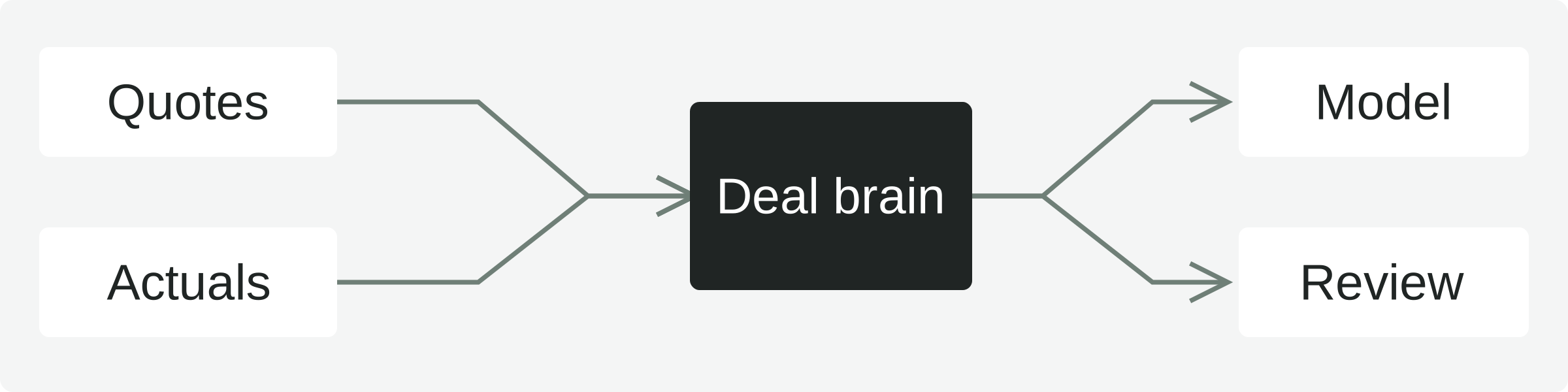
A revised quote can change financing costs, reopen a model assumption and require another approval. The graph preserves that chain, including the earlier decision. This diagram shows dependencies, not an automated investment decision.
What makes the context useful
Authority and freshness. A recent working email does not automatically outrank an approved term sheet. Track source status and dates together.
Conflicts made visible. When the model, email and document disagree, surface the discrepancy and evidence for review. Preserve unresolved questions.
Access carried forward. Apply user, team, fund and agent permissions when retrieving evidence and producing an answer.
One reusable foundation. Expose governed context through an API or SDK so screening, narratives and monitoring can use the same evidence layer.
A structured context layer improves token economics by retrieving the evidence a task needs instead of repeatedly passing entire document sets to a model. Reported savings of 60–80% fewer context tokens versus naive connector retrieval make that efficiency valuable across repeated deal workflows.
Implementation: start with an output
Choose one recurring handoff, such as a source-linked input table or underwriting package. Agree on the permitted sources, required fields, reviewer and acceptance criteria. Capture undocumented exceptions from the people doing the work.
Test against reviewed historical deals. Keep calculations reproducible in the existing model. Route missing evidence and low-confidence extraction to a person before widening the scope.
Adoption belongs in the design. Let staff submit documents through existing email or upload workflows and receive outputs in familiar templates. The business goal is more capacity for client relationships, negotiations and deal execution, with less time spent collecting files and rebuilding packages.
ROI: more intelligence, faster reporting
Intelligence across 50,000 deals. Two-minute reporting. 98% of sources linked. The opportunity is to bring more of the firm’s experience into each report while keeping the supporting evidence close to the answer.

The gains extend beyond report preparation: less time gathering documents, less repeated work between teams, faster access to pricing precedent and more broker capacity for client advice, prospecting and deal execution. The same context can support the next workflow without rebuilding its knowledge base.
Measure the business impact through reporting turnaround, analyst preparation time, source coverage and cost per completed workflow. Reusing the brain across screening, underwriting and monitoring can compound those gains.
4. Build in-house, with the right infrastructure
Own your own destiny. Your team should set the strategy, retain control of its data and build the workflows that make the firm distinctive. The technical decisions underneath those workflows determine how reliably and economically they can scale. Test against your existing tools first; a partner should demonstrate where better reasoning, data access or specialist expertise improves the result.
Permissions and data rights. Enforce user, fund and agent access through every step. Distinguish public records from licensed market data, and preserve the terms governing how each source can be used.
Long context management. Find decisive clauses across large, inconsistent deal packages without losing source references, scope or units. More documents in a prompt do not guarantee a better answer.
Freshness and reconciliation. Keep records current as files arrive piecemeal. Match them to the right property, distinguish missing documents from outdated ones, and revisit assumptions when evidence changes.
Connectors and orchestration. Coordinate email, document stores, CRM, market data and model outputs. Handle failed imports, duplicates and incomplete requests so the process can continue reliably.
Infrastructure and security. Own least-privilege access, isolated execution, audit trails, monitoring, recovery and data retention. Define deployment boundaries, data ownership and model-provider data-use terms.
Model research cycles. Evaluate models, prompts and retrieval on real deal tasks. Keep testing extraction, financial reasoning and conflicting evidence separately, with regression checks before each change reaches production.
This last responsibility is research hill-climbing: repeated experiments to improve performance as models and economics change. A model that extracts tables well may struggle with contradictory credit narratives. A cheaper model may be sufficient for one step but unsuitable for another.
At Mason, we combine operating experience from leading real estate firms with engineering and research experience from leading AI labs. We help internal teams build on the right foundation: a shared brain that connects evidence, preserves institutional context and stays useful as data and models change. Your team owns the direction. We bring the infrastructure and expertise to help it execute.
5. Use cases worth starting with
Start where a recurring output and its reviewer are already clear:
Data-room intake and follow-up. Track received documents against the checklist, identify missing or stale evidence, and prepare targeted requests for review. Reuse current records from prior work.
Pricing and quote intelligence. Assemble relevant sale and lease comparables and financing quotes, explain differences in terms and show the evidence behind a pricing comparison.
Client narrative preparation. Draft in the firm’s format from the offering memorandum, rent roll and property records. Cite figures and flag departures from relevant precedent.
Source-linked model inputs. Populate a reviewable input table. Flag partial periods, missing units and conflicting operating figures before they enter the model.
Valuation and marketing handoff. Carry the broker’s narrative and documents forward. Mark sections that still require an analyst’s judgment.
Client change briefs. Show revised assumptions, new diligence, resolved issues and outstanding conditions since the last approval.
Broker research and prospecting. Identify potential buyers, investigate leasing options and assess renewal exposure using permitted property and market evidence. Show the reasoning for review.
Learning after closing. Compare the original thesis with actual performance. Separate changed market conditions from weak assumptions, then preserve approved lessons for future reviews.
Pick one handoff your team repeats every week. Define what a reviewer must trust, measure the current effort and test it on real deals. Each completed review should leave the next team with better evidence and more of the firm’s experience available to it.
Explore all insights →